Need to Prove That Mist Nets Are Safe?

Her pain is your gain. When Erica Spotswood of the University of California at Berkeley applied to use a mist net in French Polynesia, officials asked for proof that the technique is safe. Despite the fact that the technique has been the research standard in ornithology for decades, Spotswood couldn’t find much data. So, she collected her own.

She found that mist netting is indeed safe, with injuries or deaths occurring in only a fraction of a percent of the birds captured. Best of all, the paper, in Methods of in Ecology and Evolution is open access. You can’t ask for more than that.

Read the paper here.

Some background on the study from ScienceDaily.

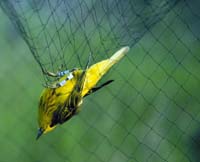
Photo: Not a bird in exotic French Polynesia, but a yellow warbler in the good old US of A. Photo Credit: Kristine Sowle, courtesy of the US Fish and Wildlife Service

Need to Prove That Mist Nets Are Safe?

Her pain is your gain. When Erica Spotswood of the University of California at Berkeley applied to use a mist net in French Polynesia, officials asked for proof that the technique is safe. Despite the fact that the technique has been the research standard in ornithology for decades, Spotswood couldn’t find much data. So, she collected her own.

She found that mist netting is indeed safe, with injuries or deaths occurring in only a fraction of a percent of the birds captured. Best of all, the paper, in Methods of in Ecology and Evolution is open access. You can’t ask for more than that.

Read the paper here.

Some background on the study from ScienceDaily.

Photo: Not a bird in exotic French Polynesia, but a yellow warbler in the good old US of A. Photo Credit: Kristine Sowle, courtesy of the US Fish and Wildlife Service

Short Commute for Florida State Biologists

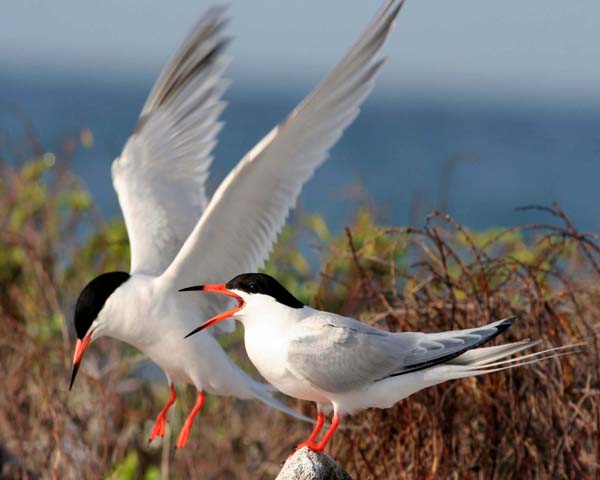
A major colony of roseate terns, a state and federally listed threatened species, is located on the roof of the Florida Fish and Wildlife Conservation Commission in Marathon, Fla., in the Florida Keys. It contains about 67 nests. The colony has been there since 1996, making monitoring the colony an easy day in the field for the state biologists working in the building below.

Read more in this article in the Florida Keys News/Marathon Free Press.

Photo: Alcides Morales, courtesy US Fish and Wildlife Service

The Cicada Paradox

Photo: Philip N. Cohen

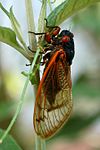
As Brood XIX cicadas emerge in the South, you would think that local birds would be preparing for a once-every-13-years feast. But, rather than flocking in and chowing down, bird numbers decline in regions experiencing a periodical cicada emergence. These declines have been confirmed by the annual Breeding Bird Count (BBC) that takes place across the country in May and June.

Scientists at Cornell University’s Lab of Ornithology, the University of Maryland, and the U.S. Department of Agriculture wondered whether the loud trill of the cicadas was drowning out bird calls, so BBC surveyors merely didn’t hear birds that were still there; whether something about the cicada emergence drove birds away from an area; or if birds experienced a true population decline during cicada emergence years.

In a study published in the journal Ecology, they compared various measures of bird populations in years of cicada emergence, and years without a cicada emergence. They also looked at those population measures in places where the cicadas could be heard, and in places where cicadas couldn’t be heard.

If it was just a matter of the surveyors not hearing birds among the din of the cicadas, the number of birds in the cicada areas would drop, while the number of birds in the non-cicada areas would stay the same. If the cicadas were driving the birds away, there would be fewer birds near the cicadas and more where the weren’t cicadas. Finally, if the number of birds declined similarly in areas with and without cicadas, then some other factor was at work.

The researchers used BBC data from the 1987 and 2004 emergences of Brood X, the periodical cicadas that live in the Mid Atlantic states. The data included whether or not the surveyors could hear cicadas at each data collection point.

They found that the number of birds declined similarly in areas where there were cicadas and areas where there weren’t cicadas within the Brood X emergence region. The findings strongly suggest a true decline in birds during these years.

What is causing that decline? The researchers could only speculate. But perhaps the mysterious environmental trigger that leads the cicadas to emerge every 13 years in the South, and generally every 17 years in the North, also influences the bird population decline — giving the cicadas the best chance of creating a new generation, without winding up as an avian snack.

Read the whole paper on the Cornell researcher’s Web site, here.

Read more about the current cicada emergence, here, in USA Today and on Nashville Public Radio.

Photo: Brood XIX cicada in Chapel Hill, NC, taken by Philip N. Cohen

Swans were poisoned, not shot

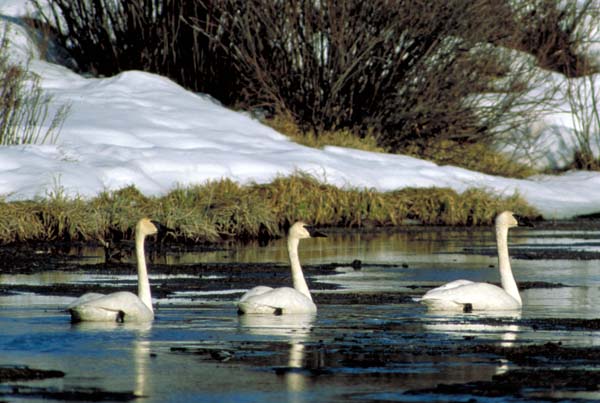
In January five trumpeter swans were found dead around the Dungeness Valley on the Olympic Peninsula in Washington State. One of them was believed to be shot because X-rays showed 41 shot ­gun pellets in the bird’s body. Trumpeter swans came near to extinction at the beginning of the 20th Century, and while they have recovered, the number of deaths in one area, and the possible shooting, were a concern.

However, further tests showed that all five of the swans had lethal levels of lead in their livers.

Local wildlife managers don’t know where the swans could have ingested the lead shot. Swans and other birds swallow stones and grit to help them grind up food in their gizzards. The wildlife managers will keep an eye out for further lead poisoning cases in the region in the future.

Read more info in this report from a local radio station. And in this article from the Peninsula Daily News.

I tried really hard to work in an “eat lead” joke here, but I just couldn’t do it.

Photo: Thomas G. Barnes, University of Kentucky, courtesy of the US Fish and Wildlife Service

Swans were poisoned, not shot

In January five trumpeter swans were found dead around the Dungeness Valley on the Olympic Peninsula in Washington State. One of them was believed to be shot because X-rays showed 41 shot ­gun pellets in the bird’s body. Trumpeter swans came near to extinction at the beginning of the 20th Century, and while they have recovered, the number of deaths in one area, and the possible shooting, were a concern.

However, further tests showed that all five of the swans had lethal levels of lead in their livers.

Local wildlife managers don’t know where the swans could have ingested the lead shot. Swans and other birds swallow stones and grit to help them grind up food in their gizzards. The wildlife managers will keep an eye out for further lead poisoning cases in the region in the future.

Read more info in this report from a local radio station. And in this article from the Peninsula Daily News.

I tried really hard to work in an “eat lead” joke here, but I just couldn’t do it.

Photo: Thomas G. Barnes, University of Kentucky, courtesy of the US Fish and Wildlife Service

Spring research round-up

<!–[if !mso]> st1:*{behavior:url(#ieooui) } <![endif]–>
Black duck
The New York State Department of Envirnmental Conservation and the New York Cooperative Fish and Wildlife Research Unit (located at Cornell University) are conducting two black bear research projects in south-central New York this season. One study will estimate bear population density using a genetic (DNA) identification technique. The other will study bear movements and habitat selection in core bear ranges and fringe areas. Read more.
Also this spring, the NJ Department of Environmental Protection Division of Fish and Wildlife’s Endangered and Nongame Species Program is teaming up with Montclair State University and the Conserve Wildlife Foundation of New Jersey for the state’s first broad-based scientific study of chytrid fungus. The study seeks to find out if chytrid fungus is having an impact on the state’s amphibian populations. More info from the State of New Jersey.
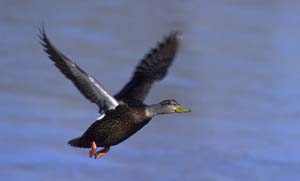
This winter the Massachusetts Fish and Wildlife Department studied black ducks along the state’s coast. The department is concerned about the birds because their numbers have been declining. Read about the study in this article from the Cape Codder, via the WickedLocal Eastham blog. The study will continue for three more years.
The Indiana Department of Natural Resources, Division of Fish and Wildlife recently completed catfish research in the Wabash River. There had been no harvest limits on large catfish in the state, and the public had expressed concerns about fishing pressure. The state is looking into regulating the fishery. Some info on the regs from the Indiana General Assembly. A report on catfish in the Wabash River.
Photo: US Fish and Wildlife Dept.

Raptors and Rat Poison

A second generation of more potent anticoagulant rodenticides (aka, rat poisons) are prevalent in raptors brought to the Tufts Veterinary School wildlife health clinic in Massachusetts, said Maureen Murray of Tufts at a session at the Northeast Fish and Wildlife Conference today.

She tested 161 raptors that were brought in dead or died at the clinic for residues of the second generation of rat poisons, which kill by causing the animal to bleed to death. She found that 86 percent of them had residues of the poison in their systems. She also found that amount of rat poison that was fatal to the raptors varied greatly between individuals. For example, on bird appeared to have died with 12 parts per billion (ppb) of the poison in its blood. Another had clearly died of other causes, even though it had 260 ppb.

Murray noted that the EPA has banned the sale of these second generation of poisons to the public, as of June. She suspects the incidence of the poisons in the environment will not decline significantly however, since they will still be available to pest control professionals.

Murray says that poisoning with these anticoagulant rodenticides should be considered when pondering unexplained raptor die-offs.

Do birds spread Lyme disease?

Birds may help Lyme disease spread into new areas, says a paper in a recent issue of Frontiers in Ecology and the Environment. The researchers, from the Yale School of Public Health, studied the literature and found that out of 71 bird species, 58.6 percent were capable of infecting a black-legged tick with the Lyme disease-causing bacterium.

That means that Lyme disease can move quickly, at the speed a bird can fly, throughout the region where black-legged ticks are found. For Lyme disease the focus is typically on the ticks’ small-rodent or white-tail deer hosts, and while those species get around, the idea of a bird host means Lyme disease has the potential to spread rapidly.

Read the Frontiers in Ecology and the Environment article here.

Similar research was being done on Cape Code (Massachusetts) a few years ago, with the focus on songbirds carrying black-legged ticks, particularly larval ticks. Read the Wicked Local story here.

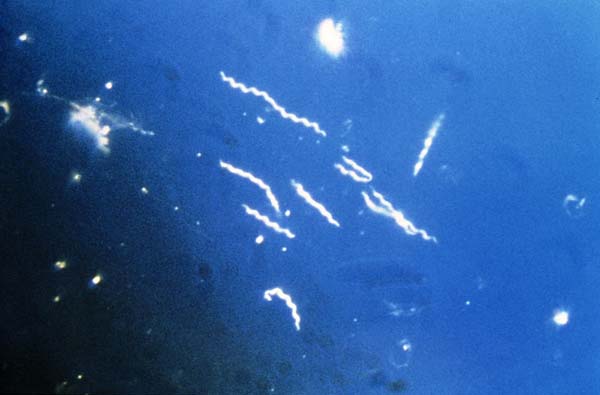
Photo: Courtesy of the Centers for Disease Control.Borrelia burgdorferi, the bacteria that causes Lyme disease, because it’s not every day that I get to post a picture of a spirochete.

Stats on two threats to birds

A study of a Wisconsin wind farm found that raptors mostly avoided the site, resulting in a big reduction of raptors in the area after the turbines went up. It also found that red-tailed hawks and turkey vultures took the most risks near the turbines, although red-tails were the only raptors found dead in the wind farm. Read the open-access article in The Journal of Applied Ecology here.

Also in the Journal of Applied Ecology, Dutch researchers found that birds breeding near noisy roadways had smaller clutch sizes than other birds. When the roads were noisy in April, the birds had fewer fledglings, regardless of clutch size. The species studied was Parus major. The paper, again, open access, is here.