
Stats on two threats to birds

A study of a Wisconsin wind farm found that raptors mostly avoided the site, resulting in a big reduction of raptors in the area after the turbines went up. It also found that red-tailed hawks and turkey vultures took the most risks near the turbines, although red-tails were the only raptors found dead in the wind farm. Read the open-access article in The Journal of Applied Ecology here.

Also in the Journal of Applied Ecology, Dutch researchers found that birds breeding near noisy roadways had smaller clutch sizes than other birds. When the roads were noisy in April, the birds had fewer fledglings, regardless of clutch size. The species studied was Parus major. The paper, again, open access, is here.
Climate change and bird feeders

Even when bird feeders are readily available, some species of birds head for warmer climes, says a paper in the latest issue of the Journal of Animal Ecology. The scientists, who are affiliated with the Cornell Lab of Ornithology’s Project FeederWatch, studied 18 bird species that are common at bird feeders in the northeastern US and found that some species of birds did not stick around over the winter in spite of there being plenty to eat at bird feeders.

They also found that the birds that stayed north in winter were more likely to visit a bird feeder during a cold snap. Finally, the scientists found that for species that tolerate urban life, such as house sparrows, the abundant bird feeders in developed areas provide a winter refuge. Species that find urban life stressful, such as downy woodpeckers, are less likely to stay in developed areas during winter.

The scientists note that when predicting how climate change will influence a bird species, these other factors, such as tolerance to urbanization, need to be considered as well.

You can find the paper here, and a simple summary of the work on the Project FeederWatch blog.

Photo: I say it’s a nuthatch, although admittedly not the nuthatch species in this study. So don’t look too closely at the bird, just look at the bird feeder and the pretty green background, OK?

Climate change and bird feeders

Even when bird feeders are readily available, some species of birds head for warmer climes, says a paper in the latest issue of the Journal of Animal Ecology. The scientists, who are affiliated with the Cornell Lab of Ornithology’s Project FeederWatch, studied 18 bird species that are common at bird feeders in the northeastern US and found that some species of birds did not stick around over the winter in spite of there being plenty to eat at bird feeders.

They also found that the birds that stayed north in winter were more likely to visit a bird feeder during a cold snap. Finally, the scientists found that for species that tolerate urban life, such as house sparrows, the abundant bird feeders in developed areas provide a winter refuge. Species that find urban life stressful, such as downy woodpeckers, are less likely to stay in developed areas during winter.

The scientists note that when predicting how climate change will influence a bird species, these other factors, such as tolerance to urbanization, need to be considered as well.

You can find the paper here, and a simple summary of the work on the Project FeederWatch blog.

Photo: I say it’s a nuthatch, although admittedly not the nuthatch species in this study. So don’t look too closely at the bird, just look at the bird feeder and the pretty green background, OK?

Old birds

The bird bands you placed on birds last season may be informing science long after you retire, a series of recent stories suggests.

A Laysan albatross named Wisdom is the oldest bird in the United States, and in North America, according to a US Geological Survey press release. The bird is at least 60 years old. It was banded while sitting on an egg in 1956, and was at that time estimated to be five years old. The bird was recently spotted at Midway Atoll National Wildlife Refuge. It has been spotted there several times in the last few years.


There’s already lots of press on this, such as this article in USA Today.

In late February, a bald eagle electrocuted on a power line in Alaska was found to be the second-oldest bald eagle in the state, and one of the oldest bald eagles in the country. The bird was 25 years old, according to its leg band. The story ran in the Anchorage Daily News.

And rounding out the tales of old birds and old bands, back in December The New York Times wrote about a red-tailed hawk in New York State that was 27 years old.

Photo: John Klavitter , U.S. Fish & Wildlife Service

Grassland predators

Photo courtesy US Fish & Wildlife
The population of dickcissels, a grassland bird, is declining nationwide. Habitat fragmentation is thought to be a key factor. Researchers monitored 33 dickcissel nests in a highly fragmented agricultural landscape in Nebraska and Iowa. They found that 20 nests were completely depredated and that three were partially depredated. The nest predators were:
-nine snakes
-six small mammals
-six raccoons
-two brown-headed cowbirds
-one American mink
One nest was abandoned because of ants. Nine of the 33 nests fledged young. The researchers found the number of snake predators notable.
The study appeared in the Wilson Journal of Ornithology.

Nestling diet study woes

Researchers saw an adult Abert’s towhee throw two nestlings out of its nest after the researchers had collared the nestlings’ throats as a part of a study of the nestlings’ diet. The researchers also observed yellow- chats retrieving food from their nestlings after throat ligatures were applied. The researchers had no problem getting food samples from song sparrow nestlings with throat ligatures.
The researchers suggest that when nestlings are small compared to their parents, the parents are more likely to heave them out of the nest when they detect a foreign object, like a throat ligature, associated with the nestling.
The paper was published in The Wilson Journal of Ornithology.
The full paper is available here.
Photo: I know, I know, not the correct bird species. US Fish and Wildlife Service

Stopover or staging area?

A stopover site is any site where one bird or many stops to rest or feed during migration, says a paper in the current issue of the Journal of Avian Biology. The term “staging area” should be reserved for “sites with abundant, predictable food resources where birds prepare for an energetic challenge (usually a long flight over a barrier such as an ocean or a desert)” the author says.

Read more from the paper in the Journal of Avian Biology here.

Make plasticine eggs

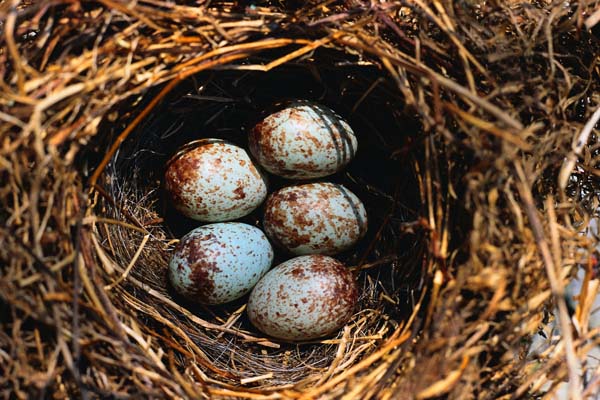
Your plasticine eggs could look like this.

Researchers at the Virginia Museum of Natural History needed a thousand eggs for a study. They decided to make them out of plasticine clay, because the plasticine eggs would show predators’ tooth and claw marks, plus, they wouldn’t rot. It took them 30 hours and they spent $250 on materials.

They published their exact method for making the eggs in The Southwestern Naturalist. You can find an open access version of the paper on this site.

Measuring citizen scientist skill and effort

Recreational bird watchers can provide a lot of data on species abundance, but how can you separate the effects of skill and effort from actual trends? Just look at the length of the species list, says this paper in the journal Ecological Applications. The length of the species list is a good indication of survey effort, when a few factors are considered. The paper tests and refines the List Length Analysis technique first developed by Australian scientist Don Franklin.

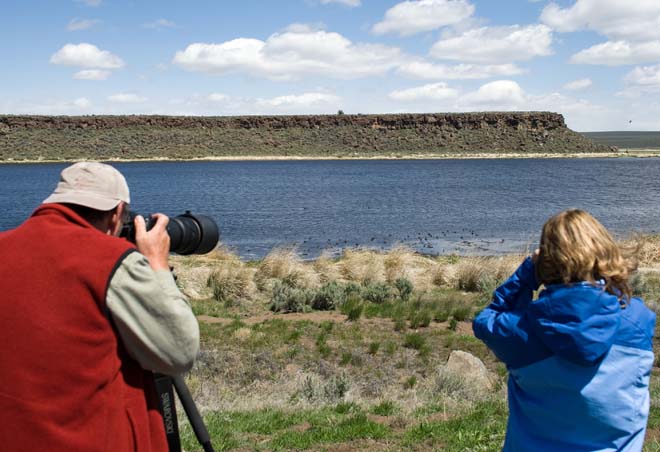
Photo: bird watchers at the Malheur National Wildlife Refuge, Oregon. Courtesy US Fish and Wildlife.