
Cat People vs. Bird People

When it comes to feral cat colonies versus bird conservation, there is not a lot of middle ground, reports a new study in PLoS ONE by researchers from North Carolina State University.

The study surveyed 577 people who either manage a feral cat colony or are a bird conservation professional. The big finding was that fewer than 10 percent of the cat colony managers believe that feral cats harmed bird populations or carried diseases.

The cat people were the optimists, however, the study showed. 80 percent of the cat people believed a compromise between the needs of feral cats and bird conservation could be reached, while only half the bird conservationists thought so.

We found the article on NewsWise. You can read it here.
It’s from a NC State U. press release, which you can find here.
Go to the article itself, in PLoS ONE, here. (Open access, so it’s free.)

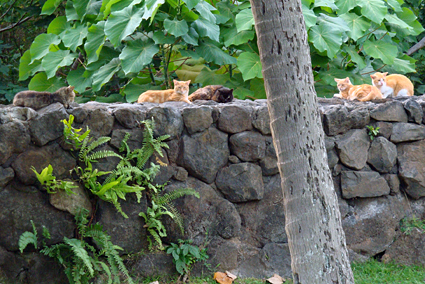
Photo: Cats in a feral colony sun themselves on a wall. Photo courtesy of Alisa Davis, University of Hawaii at Manoa, via the North Carolina State University.
Research Round-up

Earlier this summer, New York State Department of Environmental Conservation wildlife biologists banded 15 peregrine falcon chicks from five nests in western New York State. The birds are part of the growing peregrine population in the state.
Read the NYS DEC press release here.

The California Department of Fish and Game recently caught and captured 10 female deer as part of a study of habitat usage along I-280 in the San Francisco region. The information collected is part of an 18-month study that will allow scientists suggest ways to keep deer off the busy roadway.

Read the California DFG press release here.

The Michigan Department of Natural Resources, Ohio Department of Natural Resources and the U.S. Fish and Wildlife Service that a recent sampling did not find Asian carp in western Lake Erie. A week of electrofishing and gill-netting did not turn up Asian carp. The survey was conducted because last summer, DNA samples revealed the presence of the invasive carp.

Read a press release from the Michigan Department of Natural Resources here.

The Bend (Ore.) Bulletin reports that wildlife biologists will set out camera traps in the Cascade mountains hoping to catch a glimpse of wolverines, which are listed as threatened in the state.

Read the article in the Bend Bulletin here.

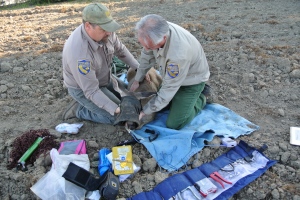
Photo: Wildlife Biologists process a sedated deer for the I-280 deer study courtesy of California Department of Fish and Game

Birds and Windows: NPR Series

Yesterday, NPR’s Morning Edition began a two part series on birds and windows. The focus of part one was on the Powdermill Avian Research Center in western Pennsylvania. Today’s story will be about “an architectural firm that’s leading the search for bird-friendly buildings.”

If you are familiar with the issues behind bird collisions with windows, the NPR story may not have news for you. But if you find yourself responding to a sudden increase in concern about bird collisions, this series during the AM drive-time may have inspired it. (It was one of the top emailed stories of the day.)

Read and listen to the NPR Morning Edition story, here. There are also photos.
You’ll find today’s story here, as soon as we get a link.

Dickcissels and Restored Grasslands

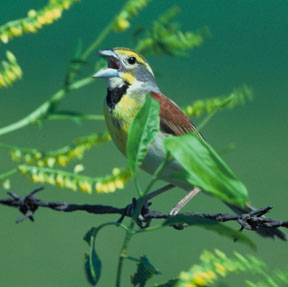
There are more dickcissels (Spiza americana) on grasslands restored with native grasses and they nest more frequently than on grasslands with exotic grasses, a study reported in the most recent issue of The Southwestern Naturalist found, but the rate of nesting success on the restored grasslands was not significantly higher.
Dickcissels are in steep decline, particularly in the heart of their range. Restoring grasslands with native species seems like a good way to slow their population decline. This paper suggests that other factors may be as important as whether the grasses in the grassland are native or exotic, such as the size of the grassland and the height of the grasses, but that overall, dickcissel nesting is more productive at restored sites .

Read the paper here (subscription or fee required to read the full text).
A little digging found that this paper is based on a master’s thesis. Read it here.

Photo: Dickcissel by Steve Maslowski, courtesy US Fish and Wildlife Service

Preventing Wildlife Deaths at Wind Turbines

Last week the journal Nature published a news feature that rounded up various ways wind power companies are trying to prevent the deaths of birds and bats at wind farms.

The article begins with one labor intensive method: a team of scientists spots a migrating raptor, then alerts the wind farm operators, who shut down the turbines until the bird is safely passed. This, it should be noted, happens in Spain, at the Strait of Gibraltar.

In Pennsylvania, a radar system (the same one we discussed earlier, the fact) detects flocks of migrating birds and shuts the turbines down. It’s not so good for single birds, though. The death of one pelican was recorded on video.

The article notes that the wind power company’s records of the radar system haven’t been shared with independent scientists studying wind turbine collisions, so the system is a bit of a black box.

The article also mentions the successful reduction of bat deaths by stopping the turbines when wind speeds fall below a certain threshold when bats are most active.

Read the whole article in Nature, here.

Birds, Wind Turbines, and Radar

In the Tehachapi Mountains north of Los Angeles, migrating birds flow through a canyon “like a living river of birds,” the Los Angeles Times says. These locations are not only attractive to birds, but to wind power developers as well.

These developers are thinking about using radar units and experimental telemetry systems to avoid killing birds, the article says.

The radar systems cost about $500,000, the article reports, and work best in flat, treeless places. (The radar company mentioned in the article, DeTect, Inc. appears to work mostly with airports, which are definitely flat, treeless places.) Several radar units would be needed in a place like the Tehachapi mountain canyon.

The article also mentions linking the telemetry units on individual condors to cut-offs at wind power facilities. If a tagged condor flies too near a wind farm, the rotors stop spinning.

Read the article in the Los Angeles Times, here.
Info on the bird and bat radar systems from DeTect, mentioned in the article, here.

Birds, Wind Turbines, and Radar

In the Tehachapi Mountains north of Los Angeles, migrating birds flow through a canyon “like a living river of birds,” the Los Angeles Times says. These locations are not only attractive to birds, but to wind power developers as well.

These developers are thinking about using radar units and experimental telemetry systems to avoid killing birds, the article says.

The radar systems cost about $500,000, the article reports, and work best in flat, treeless places. (The radar company mentioned in the article, DeTect, Inc. appears to work mostly with airports, which are definitely flat, treeless places.) Several radar units would be needed in a place like the Tehachapi mountain canyon.

The article also mentions linking the telemetry units on individual condors to cut-offs at wind power facilities. If a tagged condor flies too near a wind farm, the rotors stop spinning.

Read the article in the Los Angeles Times, here.
Info on the bird and bat radar systems from DeTect, mentioned in the article, here.

Prairie Chicken and Sage Grouse Reintroductions

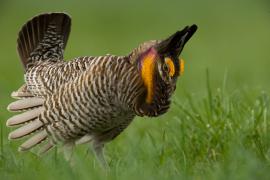
Male greater prairie chickenGreater prairie chickens are booming again this spring in Wah-Kon-Tah Prairie, Missouri. The species had been extirpated from the area until five years ago when the Missouri Department of Conservation translocated some greater prairie chickens from Kansas.
State biologists studying the birds have learned a lot about their habitat needs and have been surprised by the interplay between the donor population back in Kansas and the newly-established Missouri population.

The restoration offers hope to other states and regions trying to restore the greater prairie chicken, which is an endangered species in Missouri, when there is limited habitat available.

Read more in the Missouri Department of Conservation press release, here.

In Alberta, Canada, a two-year project to relocate some 40 sage grouse from Montana appears to be successful, says an article in the Calgary Herald. Human development, including oil drilling, had nearly wiped the species out in the province. Last year, poor weather hurt the reproduction of the introduced birds, but this year biologists believe the birds are nesting.

Read more in the Calgary Herald.

The key word mentioned in both reintroduction stories: “hopeful.”

Photo: Male greater prairie chicken courtship display, courtesy Missouri Department of Conservation

Citizen Science Season: Turtles, Birds, and Disease

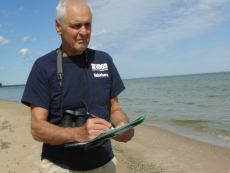
avian boultism monitoring volunteerWhere did the turtle cross the road? A citizen scientist has the answer, particularly in Massachusetts, where over the last few years citizen scientists have been tracking turtle crossings as part of the Turtle Roadway Mortality Monitoring Program. Volunteers are trained by Linking Landscapes for Massachusetts Wildlife, a partnership between Division of Fisheries and Wildlife (DFW), Department of Transportation (DOT) Highway Division and the University of Massachusetts-Amherst.
The training will take place next week.

Get more info on Linking Landscapes for Massachusetts Wildlife, here.
Read the press release in iBerkshires.com

Next week is also when Delaware Department of Natural Resources and Environmental Control wildlife biologist Matthew Bailey will introduce volunteers to monitor the state’s endangered piping plovers and other beach-nesting birds, and protect them from disturbance.

Read more about the training session, here.

There will be lots of training sessions for avian botulism monitors on Lake Michigan, perhaps because avian botulism is no where near as cute as either a piping plover or a turtle and you need to cast a wider net to get people to volunteer. Still, 44 citizen scientists volunteered with the US Geological Survey’s avian botulism monitoring program last year.

Read more about the program, here.

A home-grown citizen science project, the SeaBC Sea Bird Count, which encourages long-distance boaters to observe ocean birds and report them to eBird, took another step recently by creating a poster that can be displayed at marinas or posted on-line.

View or download the poster, here.

Photo: Avian botulism monitoring project volunteer, courtesy of the US Geological Survey

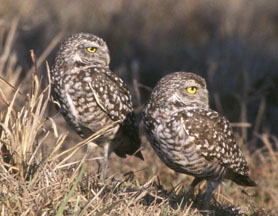
More Details on Protecting Burrowing Owls

Back in 1995, the California Department of Fish and Game released a report on burrowing owls that described how to survey for them and steps that could be taken to mitigate loss of habitat. Yet, the numbers of burrowing owls in California have continued to decline.

A new, 36-page report goes into more detail and incorporates research that has been done since the 1995 report. It includes suggested survey protocols, and buffers for various times of the year.

Read the California Fish and Game press release here.
Find the report itself (a PDF), here.

Photo by Lee Karney, courtesy US Fish and Wildlife Service