“Profound Setback” in Whooping Crane Recovery

A pair of teenagers shot two of the 10 whooping cranes released in Louisiana, hampering an attempt to establish a third population of the endangered bird, says an article in the Montreal Gazette.

The article gives the details of the whooping crane recovery program, which spans the United States and Canada, with an emphasis on Canadian contributions. It includes the fact that there were just 22 whooping cranes in 1941. The population has now rebounded to about 400 of the cranes in the wild.

The article says that state wildlife officials had created an education campaign before this fall’s goose and duck hunting season in an attempt to prevent hunters accidentally shooting the whooping cranes. The article doesn’t mention what the teenagers’ motives were.

Read the article in the Gazette here. 

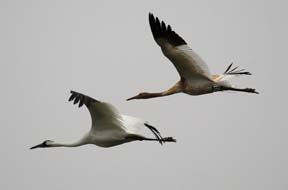
Whopping cranes had a happier visit to Missouri last week. A hunter, believing he heard someone in distress, investigated and found instead a pair of migrating whooping cranes. The cranes stayed in the agricultural field long enough for a Missouri Department of Conservation (MDC) staffer to arrive on the scene and confirm the sighting. Local bird-watchers were able to get a glimpse of the radio-tagged adult-and-juvenile pair too.

Read the MDC press release here.

Photo: Whooping cranes. Courtesy Missouri Department of Conservation
Nevada Pulls Up PVC Stakes to Save Birds

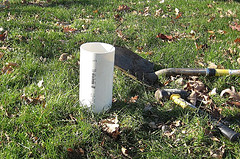
PVC pipes are cheap, light and visible from a distance. They are used all over the country as stakes to mark everything from foundation contours to mining claims. In Nevada, it’s the mining claim stakes that are the problem.

Ground nesting and cavity nesting birds are flying into the pipes, thinking they are nesting sites. But the birds don’t get out, because the pipes’ smooth interior doesn’t give them anything to grab on to. The Red Rock Audubon Society says that thousands of birds have died in Nevada in these PVC pipes. They say that bees and lizards are also trapped and die in the pipes.

It’s been illegal to mark a mining claim with an uncapped PVC pipe in Nevada since 1993, but the law has been ineffective. A new state law, SB 108, took effect last week. It allows citizens to remove upright, uncapped PVC pipes on inactive mining claims or place the stake on the ground nearby if the claim is active.

Read about the hazards of PVC pipe markers from the Red Rock Audubon Society. News of the bill’s passing is here.

Read an article in the Las Vegas Review-Journal about the new law.

Here’s the text of the law as it was actually enacted.  You can see the whole history of the bill, including the wording when it was introduced, here.

The law requires that the pipes, whether metal or PVC, be capped or crimped at the top. Comments on the Review-Journal article point out that filling the pipes with dirt would also protect birds, bees and lizards from the pipes too. Claim holders had three years to cap or crimp their pipes before the clause that allows citizens to pull them up took effect.

Photo: plerophoria67 on Flickr

Nevada Pulls Up PVC Stakes to Save Birds

PVC pipes are cheap, light and visible from a distance. They are used all over the country as stakes to mark everything from foundation contours to mining claims. In Nevada, it’s the mining claim stakes that are the problem.

Ground nesting and cavity nesting birds are flying into the pipes, thinking they are nesting sites. But the birds don’t get out, because the pipes’ smooth interior doesn’t give them anything to grab on to. The Red Rock Audubon Society says that thousands of birds have died in Nevada in these PVC pipes. They say that bees and lizards are also trapped and die in the pipes.

It’s been illegal to mark a mining claim with an uncapped PVC pipe in Nevada since 1993, but the law has been ineffective. A new state law, SB 108, took effect last week. It allows citizens to remove upright, uncapped PVC pipes on inactive mining claims or place the stake on the ground nearby if the claim is active.

Read about the hazards of PVC pipe markers from the Red Rock Audubon Society. News of the bill’s passing is here.

Read an article in the Las Vegas Review-Journal about the new law.

Here’s the text of the law as it was actually enacted.  You can see the whole history of the bill, including the wording when it was introduced, here.

The law requires that the pipes, whether metal or PVC, be capped or crimped at the top. Comments on the Review-Journal article point out that filling the pipes with dirt would also protect birds, bees and lizards from the pipes too. Claim holders had three years to cap or crimp their pipes before the clause that allows citizens to pull them up took effect.

Photo: plerophoria67 on Flickr

Good News for Trumpeters in Montana

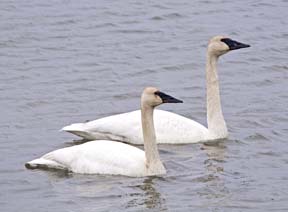
“Something went right” on the Flathead Indian Reservation in northwest Montana. The Confederated Salish and Kootenai Tribes have been re-introducing trumpeter swans there for more than a decade. This year the reservation was home to eight breeding pairs, just short of the tribes’ goal of ten breeding pairs. Over 100 cygnets have been hatched on the reservation during the program.


The program’s success was in the spotlight this week when the Trumpeter Swan Society held a conference in Montana.

Read the story in The Missoulian here.


Background on the trumpeter swan from the Cornell Laboratory of Ornithology’s All About Birds.

Photo: Alaskan trumpeter swans. Photo by Donna Dewhurst, courtesy of the US Fish and Wildlife Service.

More Bird Species Found When Willows Rebound

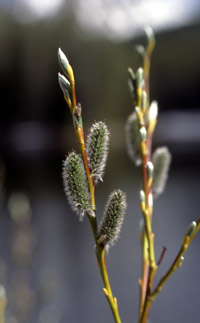
A paper in the September issue of Ecological Applications says that when previously stunted willow trees near rivers in Yellowstone National Park started to grow, the diversity of songbird species found within the willow stands increased.

The study grouped the willow stands into three types: suppressed (likely by over-browsing and -grazing by elk and bison), released (where the willows had begun to grow), and previously tall. The “released” and “previously tall” willow stands had similar range in vegetation heights, but were not distributed over the landscape in the same way.

Because the diversity of songbird species in both the released and previously tall willow stands were similar, the researchers concluded the vertical complexity was more important to supporting that diversity than horizontal complexity.

The study has implication for other places where tree growth has been stunted by over-browsing by deer, moose, elk, or other animals.

The study does not address the reason why the willows started to grow (“…a possible consequence of wolf [Canis lupus] restoration, climate change, or other factors.”), so no help there. But if you need more data on the connection between tree height and songbird diversity, you can get it in this paper.

Abstract and access to the article through subscription or fee, here on the Ecological Applications site.

A free look at the paper on a researcher’s Web site, here.

Photo: Willow catkins in Yellowstone National Park, J. Schmidt, courtesy of National Park Service.

Water on the Wing

It’s no surprise that birds lose fat during migration, but the loss of muscle mass, even when there is still fat to burn, has been a puzzle. A paper in the Sept. 9 issue of the journal Science shows that by metabolizing muscles and organs, the birds gain water.

In wind tunnel tests with Swainson’s thrushes, the researchers found that, even flying hard with no water to drink, the birds maintained their water balance in very dry conditions.

Read the paper in Science (fee or subscription required), here.

Or read the promotional blurb from the journal announcing the paper here.

NPR covered the story, as did the Los Angeles Times.

Photo: Swainson’s thrush, courtesy National Park Service

Irene Round-up

Hurricanes are a natural phenomenon, so nature pretty much takes care of itself during and after one. It’s the human factor that turns the collision of hurricane and wildlife into news. Here’s a look at how humans and wildlife are interacting after Irene:

-The US Fish and Wildlife Service has posted a list of damaged or closed facilities. It’s perhaps no surprise, considering how hard hit Vermont was, that its White River Fish Hatchery, in Vermont, is under water. Find the rest of the list, here.

-A whimbrel, a shorebird, that was tagged by a radio transmitter was tracked flying through the hurricane. It survived. Read the story in USA Today, although it appeared in many other news outlets.

-I am learning that after each natural disaster a story about how wildlife rehabilitators are assisting displaced wildlife is part of the boilerplate coverage. This time it’s wildlife rehabilitators assisting baby squirrels. I wish I were kidding.

-The storm was bad news for baby sea turtles and eggs still incubating on East Coast beaches. The Florida newspapers seem most interested in the story. Here’s one on the hundreds of baby sea turtles that turned up dead from Florida Today. And here’s one on the threat to nests from the Fort Pierce Tribune

-Finally, flooding washed sewage, pesticides and other contaminants into waterways along the East Coast. The New York Times has the story.

Photo: Hurricane Irene on Aug. 22, 2001. by NASA, via US Fish and Wildlife Service

Revised: BLM Takes the Lead in Sage Grouse Management

Please note the revision to the earlier version of this post. Changes are in blue. 

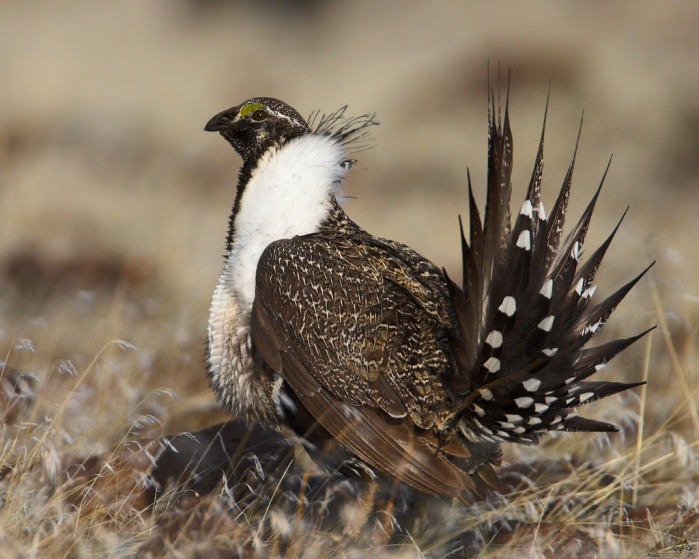
About a month ago, according to the New York Times, top state wildlife agency officials in Nevada, Colorado, Idaho and Wyoming asked the Bureau of Land Management (BLM) to take the lead in coordinating efforts to conserve the remaining greater sage grouse population, since more than half of the greater sage grouse’s remaining habitat is on BLM land. (Read the NYT article here.)

At the Western Association of Fish and Wildlife Agencies’ summer conference earlier this month, BLM more or less agreed to that role, saying that, “In response to requests from state and local governments to facilitate ways to conserve greater sage-grouse and protect its habitat” it is putting together a strategy for greater sage grouse conservation that will emphasize partnerships and agreements between stakeholders. (Read the BLM announcement here.)

The BLM’s announcement breaks greater sage grouse habitat into two sections: an eastern section where the biggest threat is energy development (oil, gas and wind) and a western section where the greatest threats are invasive species (which other sources say is primarily cheatgrass), and wildfires. (Read the further info on the plan provided by BLM here.)

The NY Times article says that the BLM plan uses Wyoming’s “core area” strategy as its base. This strategy says that only five percent of the land can be developed within four miles of a known greater sage grouse lek (or breeding area). (Read Land Letter’s article on Wyoming’s “core area” strategy here.) And yes, that restricts development on some 15 million acres in Wyoming.

A BLM spokeswoman said that it is more accurate to say that the BLM plan is “informed” by the Wyoming plan. Different strategies will be put in place in different locations, depending on on-the-ground factors. She says that the strategy is a framework, not a document. The specifics are still evolving.

Read the articles, including this one in the Sacramento Bee, for more info on the greater sage grouse’s bid for listing under the Endangered Species Act (it was deemed warranted but precluded, which is now known, confusingly, as being a “candidate” species) and how the continued threat of its listing is driving this conservation activity.

Check out these articles from WyoFile, which give a lot more detail than was available when we first posted this news:
An article about Wyoming’s management plan.
An article about whether or not sage grouse will be listed as endangered species.

Photo: Greater sage grouse by Stephen Ting. Courtesy US Fish and Wildlife Service.

Urban Bird Funds Awarded

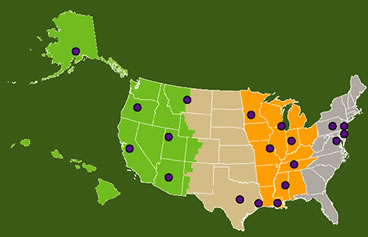
Urban Bird Treaty cities

The US Fish and Wildlife Service recently announced the ten cities that will be awarded up to $70,000 in a challenge grant for bird conservation projects. (That means the cities need to match the funds somehow.) In addition, cities previously selected for the program will receive an additional $10,000 grant.

This year’s cities range from the large (San Francisco; Washington, DC) to the small (Opelika, Ala. and Lewiston, Mont.).

Read the US Fish and Wildlife Service press release announcing the awards here. Or read more info about the Urban Bird Treaty from the USFWS Migratory Bird program, here. The next round of grants will be announced on Grants.gov.

Read the reaction of local media to the grants:
Ogden, Utah
Lewiston, Montana
Minneapolis, Minnesota

A general news article about the awards and program.

Map from US Fish and Wildlife Service

Urban Bird Funds Awarded

Urban Bird Treaty cities

The US Fish and Wildlife Service recently announced the ten cities that will be awarded up to $70,000 in a challenge grant for bird conservation projects. (That means the cities need to match the funds somehow.) In addition, cities previously selected for the program will receive an additional $10,000 grant.

This year’s cities range from the large (San Francisco; Washington, DC) to the small (Opelika, Ala. and Lewiston, Mont.).

Read the US Fish and Wildlife Service press release announcing the awards here. Or read more info about the Urban Bird Treaty from the USFWS Migratory Bird program, here. The next round of grants will be announced on Grants.gov.

Read the reaction of local media to the grants:
Ogden, Utah
Lewiston, Montana
Minneapolis, Minnesota

A general news article about the awards and program.

Map from US Fish and Wildlife Service