
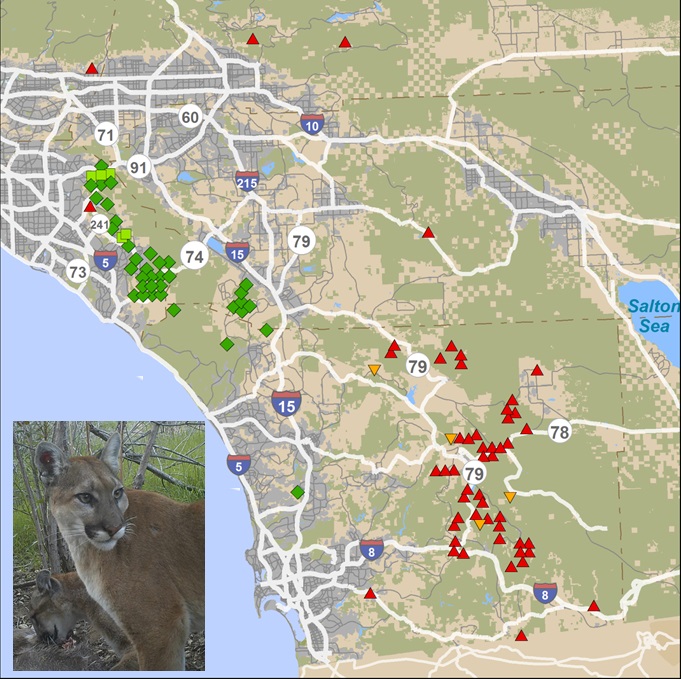
 The mountain lions of southern California are hemmed in on all sides. In one place a 10-lane highway divides mountain lion habitat. All that development is particularly difficult on a species with such a large home range.
All those highways and housing developments are putting a crimp in the mountain lions of the region’s gene pool, says a recent paper in PLoS ONE by University of California, Davis scientists. The mountain lions of the Santa Ana Mountains are no longer on speaking terms with the mountain lions of the Santa Monica Mountains. Within those population segments, genetic diversity is low.
I just covered this issue back in January (where the solution was a wildlife crossing) and wasn’t sure it was worth writing about again, but a the UC Davis press release and a Los Angeles Times article pointed out that we’ve seen this phenomenon of mountain lions hemmed in by a growing human population before — in the Florida panther. Other Puma populations may not be as distinctive as the Florida panther, but we are almost certainly sure to see this again. If there is a solution, it is a story worth following.
Read the PLoS ONE paper here.
Read the UC Davis press release here.
Read the Los Angeles Times story here.
Photo/map: This map identifies puma captures in the Santa Ana Mountains and eastern Peninsular ranges of southern California. The inset photo is of a mountain lion keeping watch while her juvenile cubs feed. Courtesy: UC Davis/The Nature Conservancy
 “What we did to protect animals actually protected roads,” said Vermont Agency of Natural Resources secretary Deb Markowitz at a general session at the Northeastern Transportation and Wildlife Conference this week (Sept. 21 – 24) in Burlington, Vermont. In places where culverts had been resized to allow wildlife to walk along the banks during low flow periods, the culverts have held during floods like the one caused by Tropical Storm Irene in Vermont.
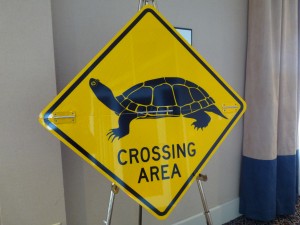 Black racer snakes are rare in Vermont, so when highway construction was going to introduce drains with holes big enough for the snakes to fall into, the Vermont Department of Fish and Wildlife asked for a fix. Drain covers with smaller holes were not possible. So the Vermont Agency of Transportation fashioned snake-sized ladders and attached them to the drains. It turns out that black racers are excellent climbers, so it is expected that the snakes will rescue themselves if they fall into the drain. A poster on the unusual solution was presented at the Northeastern Transportation and Wildlife Conference, being held this week (Sept. 21 – 24) in Burlington, Vermont.
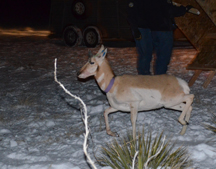 At Trapper’s Point in Wyoming, migrating pronghorns and mule deer are funneled by two rivers to 13-mile stretch of Highway 191, where they attempt to cross. Each year they endanger their own lives crossing the highway, and human lives as well,
  Canadian researchers found that European birds flee before an approaching car at an interval that is consistent with the road’s speed limit, but not with the actual speed of the approaching car. So birds on a highway fled sooner than birds on local, residential roads. The researchers studied roads in three speed categories.
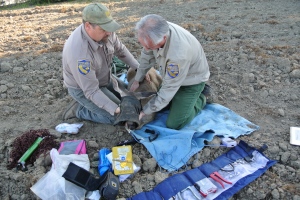 Earlier this summer, New York State Department of Environmental Conservation wildlife biologists banded 15 peregrine falcon chicks from five nests in western New York State. The birds are part of the growing peregrine population in the state.
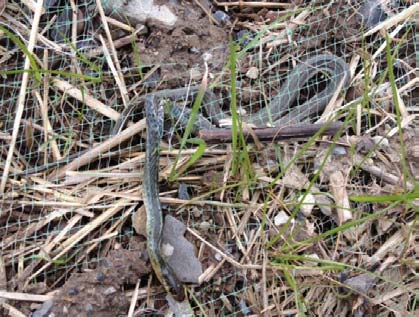 Whether its road construction, utility work, or chemical remediation, many states call for the use of some sort of landscape fabric or biodegradeable netting to prevent erosion at construction sites until plants take root.