Deer Disease News

The most recently Wildlife Health Bulletin from US Geological Survey’s National Wildlife Health Center includes a list of resources for hemorrhagic disease, including epizootic hemorrhagic disease (EHD) and bluetonge virus.

The bulletin is a two-page long PDF, but includes links to reports and news briefs as well as contact information for relevant personnel at the National Wildlife Health Center.

Find the bulletin here.

In Delaware, citizens, and particularly hunters, are being asked to report any dead deer that have signs of EHD or show no apparant sign of death. The Delaware Division of Fish & Wildlife hopes to track where the outbreaks are occurring in the state.

Read the Delaware Natural Resources and Environmental Control press release, here.

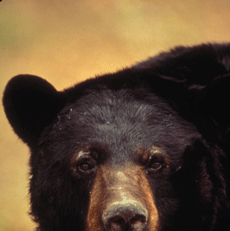
Photo: A healthy white-tailed deer, courtesy US Fish and Wildlife.

Man-Made Bat Cave Aims to Aid WNS Bats

The bat cave created by The Nature Conservancy chapter in Tennessee can be disinfected after each hibernation season, which may offer some bats a refuge from white nose syndrome (WNS). According to the Leaf Chronicle, the cave cost $300,000, which was raised entirely from private funds.

The article also notes that the cave was built near an existing bat hibernation site.

Lots of details in the Leaf Chronicle article. Read it here.
Read a shorter article in Popular Science, here.
The Nature Conservancy press release is here.
A Nature Conservancy interview with project leader Cory Holliday, here.

What the two reported articles don’t say is that the cave is an answer to a common question about possible solutions for white nose syndrome: Why don’t you just disinfect the cave with an anti-fungal? (Any doubts that this is common? See the comments after the articles.) The short answer is that a cave is a complex ecosystem and fungi play an important role. So far there isn’t a way to kill just the WNS fungus without killing other fungi in the cave.

The artificial cave doesn’t have an ecosystem, so it can be sterilized when the bats leave in the spring. This should prevent healthy bats from be infected from fungi in the cave the following winter, perhaps lessening the virulence in that cave.

It’s pricey, time-consuming and takes some of the wildness away from the bats, but compared to having wildlife rehabilitators raise a “Noah’s ark” population (which has been discussed at times with some seriousness, and even tried with Virginia big-eared bats), it’s likely cheaper, easier and less disruptive.

…And, this just in: An Associated Press story (here in the San Francisco Chronicle) does get into some of these details. Read it here.

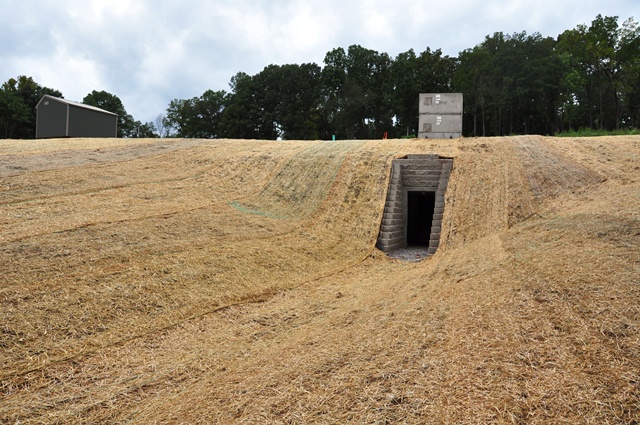
Photo: View of the artificial bat cave, with the human entrance below and the bat entrance above. Photo credit: © Cory Holliday, The Nature Conservancy

Turtles, Cougars, and Frogs in the Southwest

The current issue of Southwestern Naturalist has several articles that may be of interest to biologists outside of the region.

Yellow mud turtles decline in the Midwest. The largest populations of yellow mud turtles in Iowa, Illinois, and Missouri have experienced severe declines. Withdrawal of water from aquifers is the main cause, but the growth of woody plants also plays a role. Read the article, here. (Requires fee or subscription for full article.)
More info on yellow mud turtles from Texas Parks and Wildlife, here.

Cougar habitat in Texas and northern Mexico. Researchers from Sul Ross State University tested a model of current and potential cougar (Puma concolor) in Texas and northern Mexico and found that it worked. Read the article here. (Same for fees or subscription.)

Fungus strikes desert frogs. Chytrid fungus was found in desert oasis frog populations in Baja California Sur. The oases with higher infection rates also had bullfrogs and non-native crayfish. Read the article here.

Also interesting: Western red bats (Lasiurus blossevillii) and Arizona myotis (Myotis occultus) were found on the lower Arizona River after the area was restored. The Arizona myotis had been extirpated from the area, and the western red bat had not be found there previously. Read the article here.

Drought Impacts

The drought continues, particularly in the West, but the wildlife impact being most noticed and reported is bears coming into developed areas searching for food.

The New York Times discussed the situation, with vivid anecdotes. A Colorado State University Extension web page gives an overview on drought impacts as part of a package of drought information, with half of the info on bears. A Mother Nature Network story went beyond bears. It provides links to specific stories on drought impacts, such as one on waterfowl in USA Today and a Wyoming Star-Tribune piece on pronghorn.

The pronghorn piece mentions the impact on hunting, but the waterfowl article does not. Farmers tilling under crops early this year or not harvesting them at all, will create confusion for waterfowl hunters who may find that field they always hunted in off limits this year because of baiting regulations. This press release from the Illinois Department of Natural Resources explains some of the issues.

Cat People vs. Bird People

When it comes to feral cat colonies versus bird conservation, there is not a lot of middle ground, reports a new study in PLoS ONE by researchers from North Carolina State University.
The study surveyed 577 people who either manage a feral cat colony or are a bird conservation professional. The big finding was that fewer than 10 percent of the cat colony managers believe that feral cats harmed bird populations or carried diseases.

The cat people were the optimists, however, the study showed. 80 percent of the cat people believed a compromise between the needs of feral cats and bird conservation could be reached, while only half the bird conservationists thought so.

We found the article on NewsWise. You can read it here.
It’s from a NC State U. press release, which you can find here.
Go to the article itself, in PLoS ONE, here. (Open access, so it’s free.)

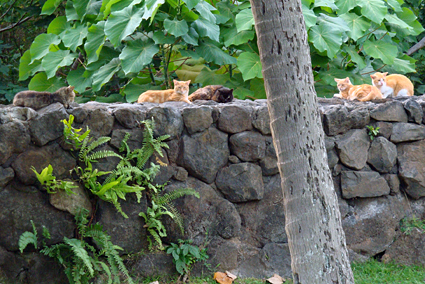
Photo: Cats in a feral colony sun themselves on a wall. Photo courtesy of Alisa Davis, University of Hawaii at Manoa, via the North Carolina State University.

Cervid Disease Update

Add New Jersey and South Dakota to the list of states reporting an epizootic hemorrhagic disease (EHD) outbreak in white-tailed deer this year. Find more info here:

New Jersey
South Dakota

Bluetongue has been reported in Missouri by CBS News. Bluetongue is another virus closely related to EHD, and is also spread by midges, a biting insect. However, some say that only cattle get bluetongue. Others say deer do too, but very rarely.

In Nebraska, the state veterinarian is saying that cattle in the state are getting EHD, which again is considered to be a rare occurrence. He is seeking more information from cattle owners whose animals are experiencing EHD symptoms (which are virtually identical to bluetongue symptoms, which is common in cattle). Read the press release here.

In Washington, hunters have been finding limping elk with deformed hooves since the 1990s. Now the disease is spreading, and Oregon Public Broadcasting has the story.

Finally, in Texas, officials had set up a containment zone when chronic wasting disease (CWD) was detected in deer on the border with New Mexico. However, the latest news from the San Angelo Standard-Times says that the new rules will be delayed until the Texas Parks and Wildlife Commission on November 7-8. According to the Austin Statesman, that’s after the archery season and a few days after the start of the standard deer season.

The Austin Statesman article has the most detail. Read it here.
The Standard-Times article is a re-print of the Texas Parks and Wildlife press release. Read the press release here.
An Outdoor Life blog also had a few words to say about the restrictions, putting them in national context. Read that here.


Python Forecast: Cloudy

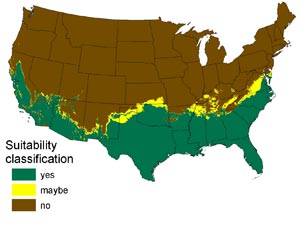
In 2008 the US Geological Survey published a report that said that the entire southern third of the United States could provide habitat for the invasive Burmese python that has been roiling the Florida Everglades ecoystem.
A recent paper in the journal Integrative Zoology says that occasional hard freezes and widespread winter temperatures that are too low for too many months of the year to allow the snakes to digest food will keep the snakes in the Everglades.

Interestingly, one of the authors of that paper is a python breeder. Another two are with USDA Wildlife Services. The lead author, a professor at a veterinary school testified before Congress in 2009 against listing constrictors as an injurious animal. (The fifth author is an expert in Burmese python digestion.)

Read the article in Integrative Zoology

A previous paper in PLoS ONE reached a similar conclusion, but for a different reason. This paper reasoned that there wasn’t enough marshy habitat north of the Everglades for pythons to spread. One notable finding in that paper was that, given climate change, the rainforests of the Pacific Northwest might someday become warm enough to be suitable habitat for pythons.

The PLoS One paper is open access.

The question is, how big of a worry is pythons crawling their way out of the Everglades into the rest of the South compared to the worry pythons becoming established in some other warm, swampy place in the United States due to the release of unwanted pets?

I would say that pythons crawling north from the Everglades through Disney World to reach the Okefenokee Swamp is a minor concern. Having another area of the US become infested with released pythons is something worth keeping an eye on.

Map: From the original 2008 USGS report. Green shows areas of the continental United States with climate matching that of the pythons’ native range in Asia.

New Nest Helps Eagles in Arizona

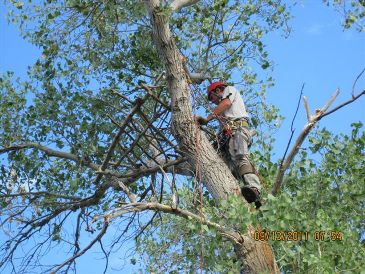
After three years of ticks killing off bald eagle nestlings in Arizona, the Arizona Game and Fish Department constructed “starter nests” in nearby trees. This year the bald eagle pair used one of the man-made nests and successfully fledged two young, says a department press release.
Several attempts to protect the nestlings from the ticks in the old nest were unsuccessful. While building the man-made nests, the old nest was removed and burned.

The press release gives more detail about the attempts to rid the nest and the tree from ticks, but does not give any detail about techniques used in the building the starter nests.

According to the release: “Bald eagle conservation in Arizona is a partnership effort of the Southwest Bald Eagle Management Committee — a group of 25 government agencies, private organizations and Native American tribes.”

Photo: Building a new bald eagle nest, courtesy of the Arizona Game and Fish Department.

New Nest Helps Eagles in Arizona

After three years of ticks killing off bald eagle nestlings in Arizona, the Arizona Game and Fish Department constructed “starter nests” in nearby trees. This year the bald eagle pair used one of the man-made nests and successfully fledged two young, says a department press release.

Several attempts to protect the nestlings from the ticks in the old nest were unsuccessful. While building the man-made nests, the old nest was removed and burned.

The press release gives more detail about the attempts to rid the nest and the tree from ticks, but does not give any detail about techniques used in the building the starter nests.

According to the release: “Bald eagle conservation in Arizona is a partnership effort of the Southwest Bald Eagle Management Committee — a group of 25 government agencies, private organizations and Native American tribes.”

Photo: Building a new bald eagle nest, courtesy of the Arizona Game and Fish Department.

CWD Hunting Season Too “Confusing” For Wisc.

The Wisconsin Department of Natural Resources wants a four-day antlerless deer hunt as part of its strategy against Chronic Wasting Disease. Wisconsin Governor Scott Walker has cancelled that hunt, reports the Pierce County Herald, saying that he is bowing to the wishes of the state’s hunters, who found the extra deer hunting season confusing and felt it took the fun out of the November season.

Read the very short piece in the Pierce County Herald.

Of course, Governor Walker has already made what he thinks of his state’s employees abundantly clear. Why hunters who don’t like the added season can’t simply not participate in it is not as clear.

Photo: Michigan does, courtesy US Fish and Wildlife